Space Division Multiple Access (SDMA)
A Study Guide for Undergraduate Electrical Engineering Students in Satellite Engineering
Introduction to SDMA
Space Division Multiple Access (SDMA) is a channel access method used in satellite communication systems that separates users based on their spatial location. By using directional antennas or antenna arrays, SDMA allows multiple users to share the same frequency band simultaneously by directing signals to specific spatial regions.
Key Insight: Unlike FDMA (frequency division), TDMA (time division), or CDMA (code division), SDMA separates users by their physical location in space, often using beamforming techniques.
Basic Concept
In SDMA, the satellite antenna system creates multiple spot beams, each covering a specific geographic area (cell) on Earth. Users in different cells can use the same frequency and time slots without interfering with each other because they are separated spatially.
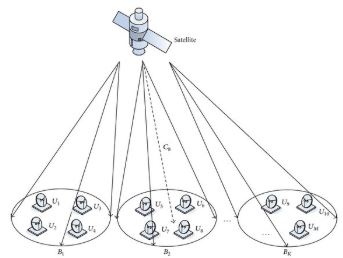
Figure 1: Conceptual diagram of SDMA with multiple spot beams
Principles of SDMA Operation
1. Beamforming Technology
SDMA relies on advanced antenna systems capable of forming multiple directed beams. These can be implemented using:
- Phased Array Antennas: Electronically steerable antennas that can form multiple beams simultaneously
- Reflector Antennas with Multiple Feeds: Large parabolic dishes with multiple feed horns
- Digital Beamforming: Using digital signal processing to create and steer beams
2. Frequency Reuse
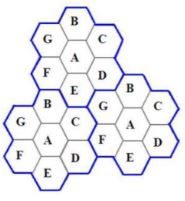
SDMA enables frequency reuse across different spatial cells, dramatically increasing system capacity. The same frequency band can be reused in non-adjacent cells to minimize interference.
Example: Frequency Reuse Pattern
Consider a satellite system with a 7-cell frequency reuse pattern. Each cell is assigned one of seven frequency bands (A-G). Cells using the same frequency are spaced far enough apart to avoid interference.
3. Spatial Filtering
SDMA systems use spatial filtering to distinguish between signals arriving from different directions. This is achieved through:
- Adaptive Beamforming: Dynamically adjusting antenna patterns to focus on desired users and null interference
- Direction of Arrival (DOA) Estimation: Determining the angle of incoming signals
- Smart Antenna Systems: Antennas with signal processing capabilities
Comparison with Other Multiple Access Techniques
| Multiple Access Method | Separation Principle | Key Advantages | Key Disadvantages | Typical Applications |
|---|---|---|---|---|
| SDMA (Space Division) | Spatial location | High capacity, frequency reuse, reduced interference | Complex antenna systems, high cost | Modern satellite systems, 5G/6G cellular |
| FDMA (Frequency Division) | Frequency bands | Simple implementation, no synchronization needed | Inefficient spectrum use, guard bands required | Traditional satellite, radio broadcasting |
| TDMA (Time Division) | Time slots | Efficient for bursty traffic, flexible capacity allocation | Requires precise synchronization, overhead for guard times | GSM, some satellite systems |
| CDMA (Code Division) | Orthogonal codes | Soft capacity limit, good frequency reuse, inherent security | Complex power control, near-far problem | 3G cellular, GPS |
Note: Modern satellite systems often use hybrid approaches combining SDMA with FDMA or TDMA to maximize efficiency and capacity.
Applications in Satellite Engineering
1. Multi-Beam Satellite Systems
Modern communication satellites like Viasat-3, Inmarsat-5, and O3b mPOWER use SDMA with dozens or even hundreds of spot beams to provide high-throughput broadband services.
2. Frequency Reuse Schemes
SDMA enables:
- 4-color frequency reuse: Four frequency bands reused across the coverage area
- Full frequency reuse: All frequencies used in every cell with advanced interference mitigation
- Adaptive frequency reuse: Dynamic allocation based on traffic demand
3. High-Throughput Satellites (HTS)
SDMA is a key technology for HTS, allowing capacities exceeding 100 Gbps by reusing frequencies across multiple spot beams.
4. LEO Satellite Constellations
Systems like Starlink and OneWeb use SDMA principles with phased array antennas to create dynamic beams that track users on the ground as satellites move across the sky.
Key Concepts and Terminology
A concentrated radio signal covering a specific geographic area, typically 100-500 km in diameter.
The technique of combining antenna elements to create a directional radiation pattern.
The practice of using the same frequency channels in different spatial cells separated by sufficient distance.
Processing signals based on their direction of arrival to separate multiple users.
An antenna composed of multiple radiating elements with phase shifters to electronically steer beams.
A geographic area served by a single spot beam in an SDMA system.
Example Problems
Problem 1: Capacity Calculation
A satellite uses SDMA with 100 spot beams. Each beam has a bandwidth of 250 MHz and uses 16-QAM modulation (4 bits/Hz). Assuming a frequency reuse factor of 4, calculate the total system capacity.
Solution:
Capacity per beam = Bandwidth × Spectral efficiency
= 250 MHz × 4 bits/Hz = 1000 Mbps = 1 Gbps
With frequency reuse factor of 4, each frequency is reused 100/4 = 25 times
Total system capacity = 25 × 1 Gbps = 25 Gbps
Problem 2: Interference Analysis
In a 7-cell SDMA cluster, if the signal-to-interference ratio (SIR) required is 18 dB and the path loss exponent is 3.5, calculate the minimum distance ratio (D/R) between cells using the same frequency.
Solution:
For a 7-cell cluster, there are 6 interfering cells at the first tier.
SIR = 10 log₁₀(R⁻ⁿ / 6D⁻ⁿ) = 10 log₁₀(Dⁿ / 6Rⁿ)
18 dB = 10 log₁₀((D/R)³·⁵ / 6)
10¹·⁸ = (D/R)³·⁵ / 6
63.1 × 6 = (D/R)³·⁵
D/R = (378.6)¹/³·⁵ = 378.6⁰·²⁸⁶ ≈ 4.6
Self-Assessment Quiz
Test your understanding of SDMA concepts with these questions:
Question 1
What is the primary separation principle used in SDMA?
Question 2
Which antenna technology is most commonly associated with SDMA implementation?
Question 3
What is the main advantage of SDMA over FDMA in satellite communications?
Question 4
In SDMA, what is a "spot beam"?
Further Reading and References
Textbooks
- Roddy, D. (2014). Satellite Communications. McGraw-Hill Education.
- Maral, G., & Bousquet, M. (2020). Satellite Communications Systems: Systems, Techniques and Technology. Wiley.
- Pratt, T., Bostian, C., & Allnutt, J. (2002). Satellite Communications. Wiley.
Research Papers
- Lagunas, E., et al. (2021). "Beamforming and Scheduling for SDMA in Satellite Systems". IEEE Transactions on Wireless Communications.
- Angeletti, P., & Rinaldo, R. (2018). "Multi-Beam Antenna Systems for Satellite Communications". International Journal of Satellite Communications and Networking.
Online Resources
- IEEE Xplore Digital Library - Search for "SDMA satellite"
- ESA (European Space Agency) Technical Documents
- NASA Space Communications and Navigation Resources